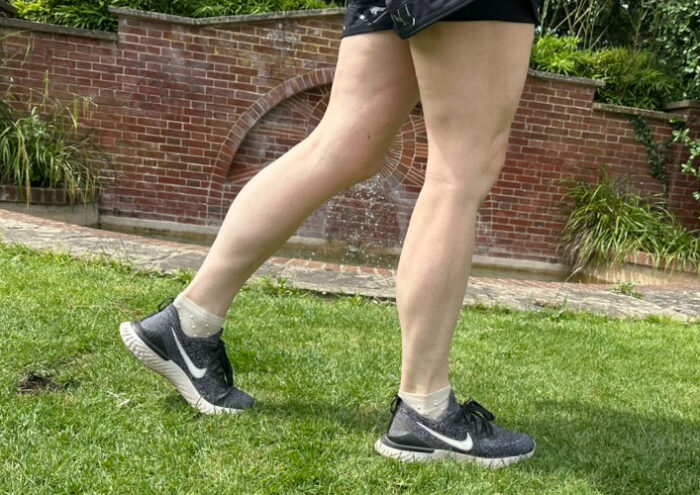
Whether you’re taking your first few steps after years of inactivity or already enjoy a daily stroll, walking is one of the easiest and most effective ways to support your weight loss journey.
Walking on GLP-1s: why it counts
Weight loss drugs help reduce appetite and calorie intake, but they don’t replace the benefits of movement. Walking supports your body in ways that medication simply can’t.
Regular walking can help:
- preserve muscle while you lose fat
- improve heart health
- improve blood sugar control
- reduce stress and anxiety
- boost mood and energy
- improve sleep
- reduce constipation
- make it easier to maintain your weight after stopping medication.
Think of weight loss drugs as helping you eat less. Walking helps your body become healthier, stronger and more resilient.
That’s why experts recommend combining GLP-1 medications with regular physical activity.
Related reading: Exercise on weight loss drugs https://www.slimrchat.com/exercise-on-weight-loss-drugs/
Forget 10,000 steps – start where you are
For years we’ve been told that everyone should aim for 10,000 steps a day.
The interesting thing is that this number wasn’t originally based on medical research. It actually came from a Japanese marketing campaign for a pedometer in the 1960s. It was memorable and catchy, so it stuck.
Today’s research paints a different picture.
Studies suggest that many of the health benefits of walking occur well before 10,000 steps. In fact, research from the University of Sydney found that around 7,000 steps a day is associated with significant improvements in overall health and a lower risk of premature death.
That should come as a huge relief!
If you’re currently walking 2,000 or 3,000 steps a day, you haven’t failed. You’re already moving in the right direction.
Our walking philosophy
Rather than chasing an arbitrary number, we prefer something much simpler:
Move. Move a little more. Repeat.
That’s it.
If you’re doing very little exercise today, don’t suddenly try to walk 10,000 steps tomorrow.
Instead:
- Walk for five or ten minutes.
- Repeat tomorrow.
- Add another few minutes next week.
- Gradually build confidence and fitness.
Consistency beats intensity every time.
Every step matters
Walking is often underestimated because it’s gentle but don’t confuse “gentle” with ineffective.
Walking activates large muscle groups, increases your heart rate, burns calories and improves circulation.
It also helps preserve muscle while you’re losing weight – something that’s particularly important on GLP-1 medications.
Many people focus only on the number on the scales but maintaining muscle is just as important as losing fat, particularly if you want to keep the weight off long term.
Read more: Your Protein Manifesto – How to Prioritise Protein
https://www.slimrchat.com/your-protein-manifesto-how-to-prioritise-protein/
Carrying extra weight
If you’re living with obesity, the idea of exercise can feel daunting.
Walking is often the perfect place to begin.
It’s:
- low impact
- free
- accessible
- easy to build into daily life.
You don’t need specialist clothing or equipment. You don’t even need to walk particularly far – five minutes is infinitely better than no minutes.
As your fitness improves, you’ll naturally find yourself walking further, more often and with greater confidence.
Mind and body
Many SlimrChat members tell us that walking becomes much more than exercise.
It’s time to:
- clear their head
- reduce stress
- listen to music or podcasts
- spend time in nature
- escape the kitchen
- reduce food noise.
Even a short walk after work or after dinner can help reset your mindset.
If you’ve read our article on understanding food noise, you’ll know that changing your environment is often one of the simplest ways to quieten constant thoughts about food.
Walking can be part of that strategy.
Match your personality
Not everyone enjoys exercise in the same way and that’s perfectly normal, we are all different. Our article on exercising based on your personality explains how different personality types stay motivated.
For example:
- If you’re highly conscientious, schedule your walks into your diary.
- If you’re more extroverted, invite a friend.
- If you’re introverted, enjoy a quiet walk with a podcast or audiobook.
- If you struggle with motivation, focus on simply putting your shoes on. Once you’re outside, the rest usually follows.
There’s no right way to enjoy walking.
The best walk is the one you’ll actually do.
Related reading: How to exercise based on your personality type
https://www.slimrchat.com/how-to-exercise-based-on-your-personality-type/
Simple 4-week plan
There’s no need to overcomplicate things; here is a suggested timetable of gentle progression:
| Week | Goal |
| Week 1 | Walk every day, even if it’s only 10 minutes. Build the habit. |
| Week 2 | Add 500–1,000 steps each day if comfortable. |
| Week 3 | Walk a little further or slightly faster on two or three walks. |
| Week 4 | Build towards a level that’s realistic for you. For many people, around 7,000 daily steps is an excellent long-term goal. |
Don’t feel there are targets you have to achieve for anything to be worthwhile! Any activity is worthwhile and there is no prize for getting there quickly.
The goal is to create a habit you’ll still be doing six months from now.
Remember…
Weight loss drugs can help you eat less. Walking helps you live more.
It protects muscle, improves your heart and lungs, boosts your mood and lays the foundations for maintaining your weight once the medication stops.
Don’t worry about being perfect. Don’t compare yourself with other people. Just remember the SlimrChat philosophy:
Move. Move a little more. Repeat.
If you can do that consistently, you’ll be giving yourself one of the greatest gifts for long-term health.